How crypto exchanges earn money — fees, spreads and the myth of free
A longer answer to the old site’s “How Does a Crypto Exchange Platform Earn Money?” — trading fees, hidden spreads, listing, staking-as-a-service, order-flow analogues, and why a MAS-licensed app and an offshore clone do not share a business model.
Editorial Desk · 8 January 2026 · Updated 8 January 2026
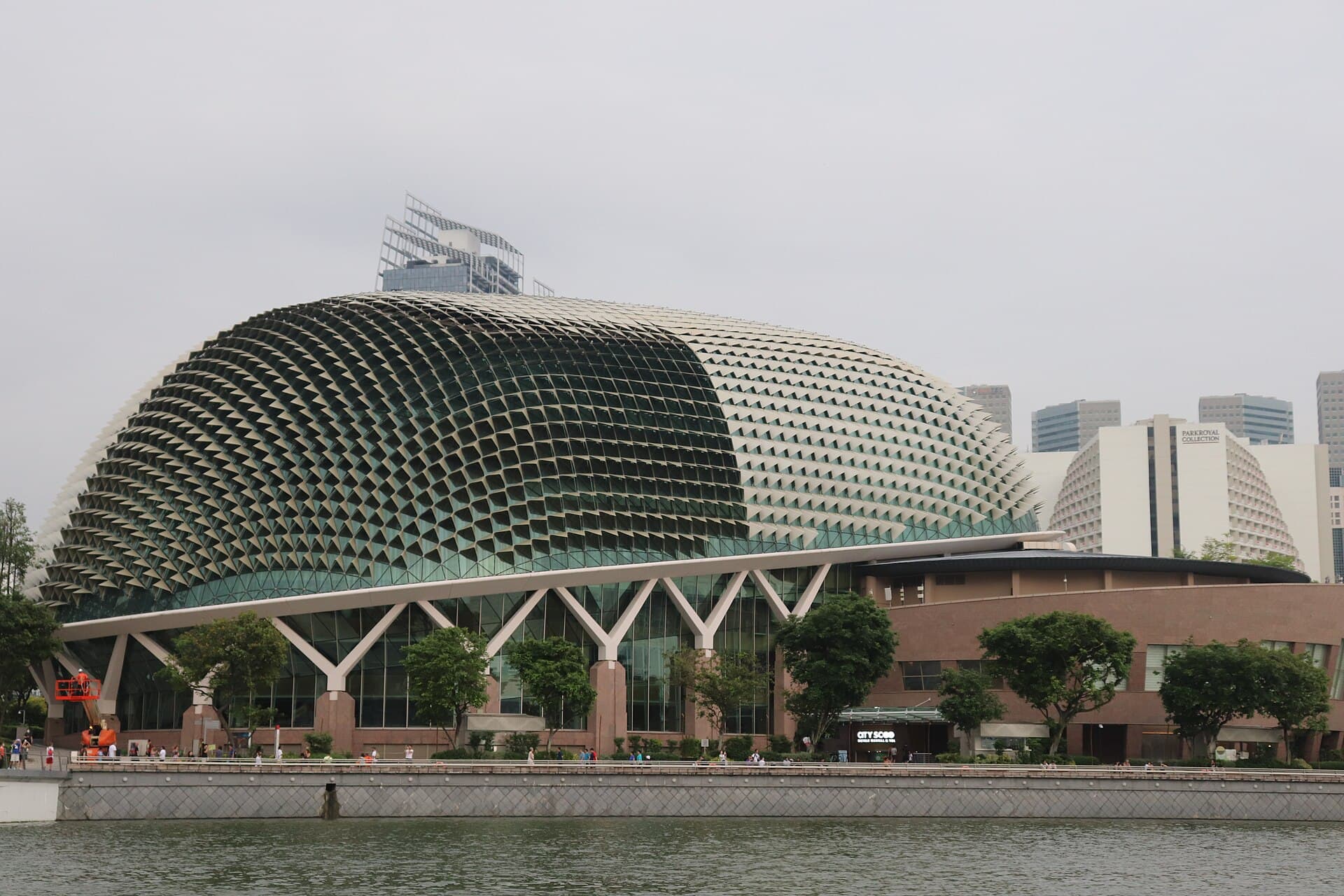
Image: Esplanade – Theatres on the Bay — Maffeth.opiana / CC BY-SA 4.0. See the image credits page.

The old cryptonews.sg asked a blunt question that still deserves a longer answer: How Does a Crypto Exchange Platform Earn Money? In the short-item era the reply was a list — trading fees, listing fees, a bit of “other” — and a stock photograph of a trading floor the industry did not own. The question is better than the old answer. A platform that shows you a price is not a charity, and a platform that shows you a zero is not a saint. Someone is paying.
This briefing maps the ordinary revenue lines, the ones that hide in the spread, and the ones a MAS-licensed digital payment token (DPT) platform is not supposed to lean on. It is not a recommendation to open, close or fund any account. For the market-structure vocabulary behind a “price”, read liquidity, spreads and weekend gaps. For the retail rules that change the product, read consumer safeguards on DPT platforms. Both sit with this page among the explainers.
The visible bill: maker, taker, withdrawal
The line item everyone can find is the trading fee. Many books charge the person who crosses the spread (the taker) more than the person who rests an order (the maker). The percentages look small until you multiply them by how often the interface invites you to tap.
A withdrawal fee, charged in the token or in a network unit, is the second visible bill. Sometimes it is a pass-through of a busy network’s auction. Sometimes it is a platform margin wearing a gas costume. Internal transfers between two users of the same app may cost nothing because they never touch a chain; they are book entries. That is cheaper. It is also how people forget they are still inside one firm’s ledger.
Conversion fees — Singapore dollars to a stablecoin, a stablecoin to bitcoin, bitcoin back to dollars — are often where a “zero trading fee” campaign recovers its dignity. The large number on the screen is not the all-in price.
Brokers have charged commissions since there were brokers. The retail habit is to treat the headline fee as the whole cost, then be surprised by the rest.
The quieter bill: you are the spread
A platform does not have to charge a commission if it can buy from you a little cheaper than it sells to the next person. The bid-ask spread is that gap. On a competitive book, during a weekday afternoon in Singapore, the gap on a major pair can be thin. On a quiet token, at 2am, or on a conversion screen that never shows the ladder, the gap can be the entire business.
Some apps do not show a book at all. They show a single price and a “buy” button. That is a dealer quote, not an exchange in the matching-engine sense. The firm, or a market-maker sitting behind the firm, is taking the other side. The revenue is the difference between the wholesale price and the retail one, plus any fee that was not mentioned.
This is also where payment for order flow becomes a useful analogy rather than a conspiracy theory. In some equity markets, a broker routes your order to a wholesaler and is paid for the privilege. Crypto has cousins of that arrangement: internalisation (the platform takes the trade), preferencing of a particular market-maker, and conversion desks that never send you to the public book. You need to ask who is on the other side, and how they are paid.
A worked picture, with invented round numbers for teaching. The screen says 100,000 Singapore dollars per bitcoin, “zero fees”. The firm’s wholesale bid is 99,700 and its offer to you is 100,300. You have paid 300 dollars of economic spread on the way in. Sell back through the same window after the mid has not moved and you pay it again. The campaign was accurate about the commission line. It was silent about the window.
“Zero fee” is a claim about one invoice. The economic cost of a trade is fee plus spread plus conversion plus the withdrawal you will eventually make. A headline that names only the first is a marketing choice.
Listing, marketing, and the tokens that pay to be seen
Listing fees — what a token project pays a venue to be switched on — are an old controversy and a durable revenue line. Sometimes the fee is cash. Sometimes it is a block of the token. Sometimes it is a “marketing partnership” that is a fee with a nicer name. The customer-facing risk is obvious. A listing is not a due-diligence stamp. It is a commercial decision. A licensed Singapore platform has extra reasons to refuse a token that looks like a capital-markets product it is not authorised to deal in. An offshore venue may treat the listing calendar as advertising.
Retail readers meet this as a press release. “Now available on…” is not a quality signal. It is, sometimes, evidence that someone wrote a cheque.
Related, and easier to miss: data, advertising and VIP programmes. Large clients negotiate fee tiers. Market-makers receive rebates. Token issuers buy banners. None of that is automatically improper. All of it means the platform has more than one customer. When those interests conflict, the conflict will not be announced in the app’s large type.
Staking-as-a-service, and the yield that is not a deposit
Many platforms offer to “stake” a token for you. The household translation is: the firm, or a vendor the firm uses, locks the asset in a protocol that distributes new units to lockers, and the firm keeps a cut.
Why the screen says APY
The industry borrowed a bank word. The risks are not bank risks.
- Lock-up. You may be unable to withdraw while an unbonding period runs. A price move during that period is your move.
- Slashing. Some protocols punish the operator for misbehaviour or downtime. Whether that punishment lands on the customer depends on the small print.
- Smart-contract and vendor risk. The coins may sit in a program or with a sub-custodian you never chose.
- Platform risk. You still have a claim on a firm. If the firm fails, “staked” is not a magic word in an insolvency.
MAS-licensed DPT platforms that hold customer assets must segregate them and must not treat them as working capital. That is a conduct rule, not a yield guarantee. A staking product that rehypothecates customer tokens, or that promises a return from the firm rather than a protocol distribution, is closer to the firm taking a balance-sheet risk with your asset. This newsroom will not tell you to use or avoid the button. It will say the button is not a fixed deposit, and the Singapore Deposit Insurance Corporation does not know your ticker.
Offshore apps have been freer with “earn”, “savings” and “flexible”. Some of those products were unsecured loans to the platform or to its affiliates. Readers who lived through 2022 need the category, not the names: a yield screen can be a credit product.
Credit, leverage and incentives — the lines Singapore closed
A global exchange’s most profitable years were not always its cash-spot years. Derivatives, margin, and the gamification that keeps people in the order book are where volumes, and liquidations, live.
On a MAS-licensed DPT platform serving retail customers in Singapore, several of those lines are supposed to be shut.
- No financing or margin for retail DPT trades.
- No credit-card or credit-line purchases of DPTs.
- No incentives that exist to induce retail customers to transact — welcome bonuses, volume-tied fee holidays, prize leaderboards, “trade and earn” points.
The licensed app therefore looks commercially duller. That is the policy. Revenue has to come from the plainer charges. An offshore clone of the same brand can still offer the closed lines. That is not evidence that the Singapore rules are optional. It is evidence that you have left the perimeter.
A reader who compares a 0.1 per cent advertised fee on a licensed platform with a “zero and a bonus” offshore screen is not comparing two prices. They are comparing two products.
Licensed versus offshore is a business-model split
The old article treated “the exchange” as one creature. It is at least two.
A licensed Singapore DPT platform is a payment-services business under the Payment Services Act, with custody, AML, complaints and consumer-access duties. It may still lose your money through a hack, a token collapse, or its own insolvency. Segregation improves the starting position. It is not a compensation fund. Shareholders want a profit, taken in ways the notices allow.
An offshore platform that is not licensed to serve Singapore customers is a different firm, even when the logo matches. It can take credit-card flow, offer leverage, pay you to trade, and list tokens a local licence would not touch. It can also fail in a court you will not enjoy, in a language your lawyer does not speak, with a customer-asset story that was never written for the Authority.
Providing DPT services to Singapore customers without the right licence is an offence for the provider. Whether a resident should use an offshore app is a judgement this newsroom will not make. The narrower point is enough: the way the firm earns money is part of the product you are buying. A firm that earns money by lending you the funds to trade is not the same product as a firm that earns money by charging you to convert Singapore dollars on a Tuesday.
How to read a fee page without being sold
A practical checklist, not a shopping recommendation:
- Find the taker fee, the maker fee, and any VIP schedule. Ask what volume that schedule assumes.
- Find the withdrawal fee for the asset and network you would actually use.
- Find the conversion path from SGD. If the app only shows a US-dollar book, you have an FX spread as well.
- Look at a ladder, if one exists, at the size you would trade — not the last price.
- Read the staking or “earn” paragraph until you can say, in your own words, whose balance sheet you are on.
- Check whether the entity in the terms is the MAS-licensed entity or an overseas affiliate.
If any of those sentences is hard to complete, you do not yet know how the platform earns money from you. You know how it advertises. The old site was right to treat the business model as news. A venue’s revenue is the customer’s cost, collected in public or collected in the gap. “Zero” is a word. The bill is the rest.
Questions readers send the desk
- If an exchange advertises zero trading fees, is the service free?
- Almost never in economic terms. The firm can still earn the gap between the price you see and the price you receive, a conversion spread into Singapore dollars, a withdrawal charge, or a wholesale arrangement you never see. “Zero” is a headline about one line item.
- Do MAS-licensed platforms make money the same way as offshore apps?
- Some of the pipes are similar — matching, custody, conversions. The Singapore perimeter closes others. Licensed digital payment token platforms must not dangle retail trading incentives, must not offer retail leverage or credit-card purchases, and must safeguard customer assets rather than treat them as working capital. The remaining revenue has to come from plainer charges.
- Is staking-as-a-service just interest on my tokens?
- No. You are usually locking an asset in a protocol or with a service, taking slashing, lock-up and smart-contract risk, and paying the platform a cut of whatever the protocol distributes. It is not a bank deposit, and it is not covered by deposit insurance.