Self-custody versus licensed platforms — a trade-off, not a verdict
Counterparty risk against operational risk, inheritance against a helpdesk, a MAS-licensed book-entry against a seed phrase you can lose — an educational fork for Singapore readers, without recommending either side.
Editorial Desk · 28 March 2026 · Updated 28 March 2026
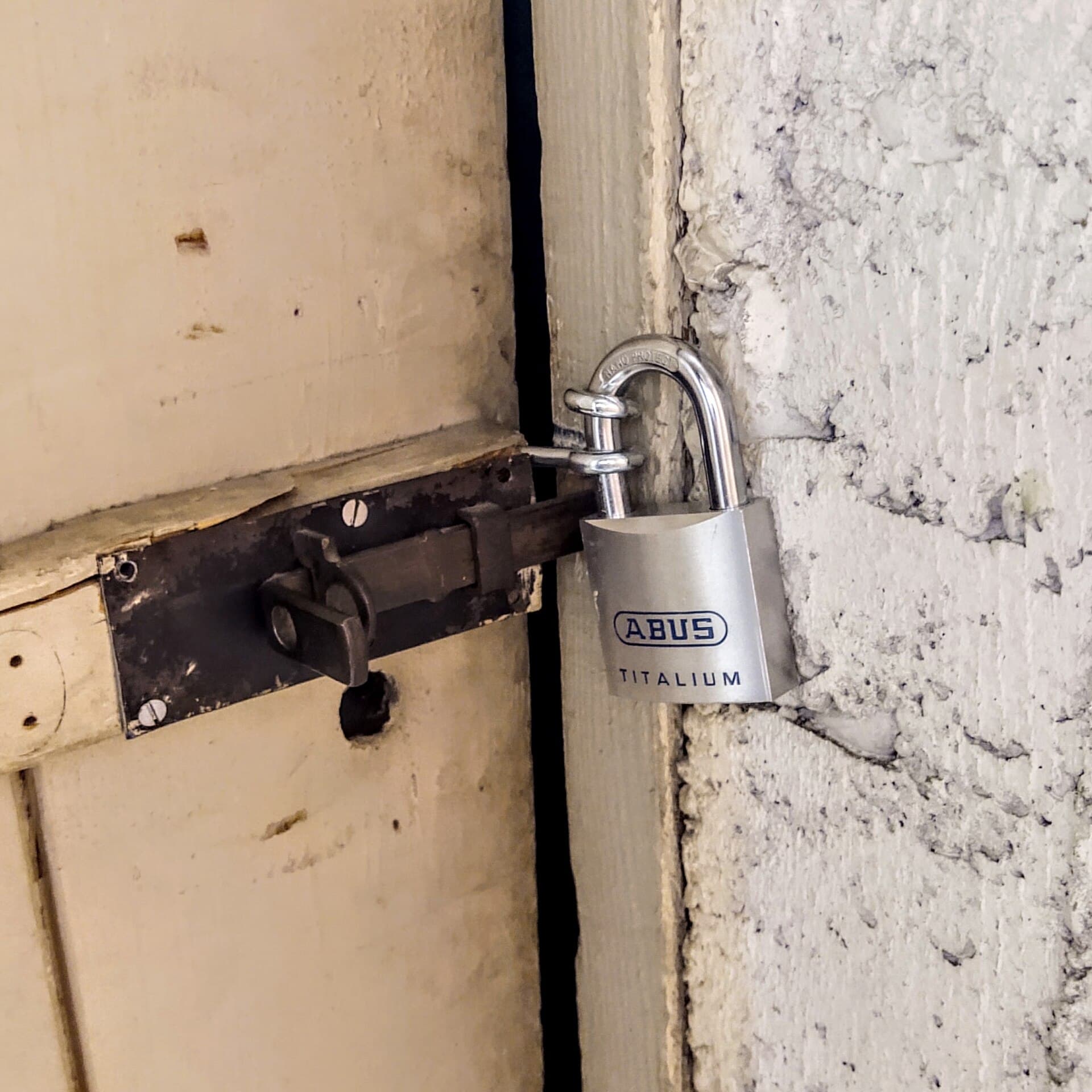
Image: Padlock — Michael Musto / CC BY-SA 4.0. See the image credits page.

Singapore – The argument arrives pre-loaded. One camp says that if you do not hold the keys you do not hold the asset, and that a licensed app is a polite version of someone else’s pocket. The other camp says that a seed phrase in a kitchen drawer is how families lose a year’s savings, and that a Monetary Authority of Singapore (MAS) licence is the grown-up choice. Both camps are describing a real failure mode. Neither is describing a verdict this newsroom is willing to issue.
This briefing is the fork, not the shopping trip. It does not recommend self-custody, a hardware device, or an account at any platform. For the mechanical vocabulary of keys and accounts, start with crypto wallets explained for Singapore. For what a failure looks like when the firm is the one that breaks, see when a crypto exchange fails. The operational half of the story lives in the security hub.
Two risks with the same ticker
Put the same token on the screen in two arrangements and you have two products.
In self-custody you hold the secret that can sign a valid transfer. The network records a balance against an address. If you can sign, you can move. If you lose the secret, or if someone else copies it, the network does not care who was “supposed” to own the coins. There is no issuer in Singapore who can reset the book because you asked politely.
In a licensed-platform account you hold a claim on a firm. The firm holds keys, or uses a custodian, under whatever safeguarding arrangement its Payment Services Act licence and the related notices require. You have a login, a complaints path, and a regulator who can inspect the firm. You do not, in the usual retail set-up, have the seed. You cannot restore the balance in a competitor’s app. You can file a ticket.
The token’s name can be identical. The failure is not.
Counterparty risk is what you take when the firm is in the middle: insolvency, a frozen withdrawal queue, a hack of the custodian, a compliance hold that lasts through Chinese New Year, a dispute about whose book entry is whose. Operational risk is what you take when you are the operations department: a lost notebook, a house fire, a phishing page, a mistyped address, a relative who tidies up, a you who is in hospital and did not leave instructions.
People who have only been burned by one of these will talk as if the other were theoretical. This desk will not.
What a MAS-licensed platform actually changes
A firm that provides digital payment token services to the Singapore public generally needs a licence. The licence is permission to carry on specified activities — dealing, exchange, transfer, custody — not a quality stamp on any token and not a promise that you will be made whole.
What the perimeter is for, at the retail layer:
- Customer assets are supposed to be segregated from the firm’s own, reconciled, and held in a way that would still make sense if an insolvency practitioner arrived on a Monday.
- Retail customers should pass a risk-awareness assessment before they trade.
- Credit-card purchases, financing, margin and incentives to trade are supposed to be off the table.
- Advertising is constrained. Complaints are supposed to have a process, not only a chatbot.
- The Authority can require information, issue directions, and, in the ugly cases, take enforcement action.
What the perimeter is not for:
- Deposit insurance. The Singapore Deposit Insurance Corporation covers eligible deposits at participating banks and finance companies. A DPT balance is not that.
- Instant withdrawals on a Sunday because you are anxious.
- A guarantee that a listed token will keep its value, or that a lookalike token was the one you meant.
- A bypass of the network’s irreversibility once a withdrawal has been broadcast and confirmed.
A licensed account is still a counterparty. It is a supervised counterparty. That is already a lot, relative to an anonymous website. It is not a vault at the Authority. Readers who want the failure in slow motion should read the companion piece linked above rather than assume “segregated” means “returned tomorrow”.
Offshore apps, including clones of a brand that also has a Singapore entity, do not automatically inherit this perimeter. The terms will name a company. Read the name.
What holding your own keys actually changes
Self-custody restores the bearer-instrument property that makes digital payment tokens interesting to treasurers and terrifying to estates.
You can move assets without asking a platform’s permission, subject to the network, to any issuer-level freeze the token itself supports, and to your own ability to construct a valid message. You can inspect the address on an explorer. You can interact with applications a licensed platform will never list — which is a capability, not a compliment.
You also become the single point of failure that a helpdesk would otherwise have been.
The ordinary ways this goes wrong
- The seed phrase is photographed, emailed, stored in a cloud “vault”, or typed into a website that looks like support.
- The only copy is in a drawer that a plumber, a burglar, or a flood can find.
- A hardware device is bought from a random listing and arrives pre-initialised.
- A test transfer is skipped and the entire balance follows a mistyped character.
- A smart-contract approval, granted on a tired evening, is still valid next Tuesday.
None of those requires a sophisticated adversary. Most losses in this city are still social engineering and sloppy backups, not cinematic hacks.
Self-custody also does not make you invisible to the law. Exchanges you later use will still ask where funds came from. Issuers with a freeze function can still freeze. A police investigation can still exist. “I held my own keys” is not a jurisdiction.
A licensed account is a supervised claim you can lose to a firm. A seed phrase is a secret you can lose to yourself, to a relative, or to anyone who asks for the words. The ticker does not tell you which loss you are choosing.
Inheritance, incapacity, and the conversation people skip
Singapore households are good at some kinds of succession: a will, a joint account, a safe-deposit box, a child who knows which lawyer. Digital payment tokens break the pattern in two directions, and both are easy to romanticise.
If the assets sit on a licensed platform, an executor has a firm to write to, a set of terms, and a chance — not a certainty — that a grant of probate and the platform’s process will move the balance. The firm may freeze the login when it learns the customer has died. That can be protective. It can also be slow. The executor still has to be the right person with the right papers. A password shared “just in case” is a security incident as well as an estate plan.
If the assets sit in self-custody, there is no firm that can reconstruct a lost secret. An executor who does not have the words, or a workable split-control scheme, has a public-ledger fact and no key. The coins are not in the estate in any practical sense; they are at an address nobody can sign for. Families then meet a second industry: people who offer to “recover” wallets. Some are forensic specialists with a narrow, honest brief. Many are thieves with a form.
Incapacity is the quieter cousin. A stroke, a long ICU stay, a person who is alive and cannot find the notebook. Platforms have mandate and lasting-power-of-attorney conversations, imperfectly. A seed phrase has the conversation you had at the dining table, or it has silence.
This is not an argument for either side. It is the question that should have been in the old wallet-launch pieces and was not: who can move this if you cannot? If the answer is “nobody, that is the point”, you have made a political statement that your next of kin may not have agreed to. If the answer is “the platform, I suppose”, you have accepted a counterparty on a day you will not be there to file the ticket.
A table in prose, because the internet loves a winner
Who can take the asset without your live consent? On a platform: the firm, a court order it obeys, a person with your login. In self-custody: a person who has the secret, a bug or approval you signed, an issuer freeze if the token supports one. Not a helpdesk. Not MAS.
Who can give it back if you make a mistake? On a platform: sometimes, if the mistake never hit a chain. Almost never, once a withdrawal has confirmed. In self-custody: a recipient who feels generous. That is a favour.
What does a bad decade look like? On a platform: the firm is gone, the queue is long, the legal process is a process. In self-custody: the words are gone, or they were never only yours. People who want a recommendation are asking this desk to pick their bad decade. We will not.
How to have the conversation without a slogan
A practical sequence, still not a recommendation:
- Name the threat you actually have. A reader who loses paper and a reader who does not trust firms are not in the same story.
- Name the amount you cannot afford to mistype, and the amount you cannot afford to have stuck in a withdrawal queue. Those may be different numbers.
- Read the platform’s entity name, licence description and safeguarding language, or admit you have not.
- If you hold keys, write down — on paper, not in a group chat — where the backup lives and who is allowed to know that it exists. Then ask whether that person can be trusted with the whole secret. If the answer is uncomfortable, you do not yet have an estate plan.
- Use a small test transfer in either direction before you use a large one. This is hygiene, not a trading strategy.
Singapore is a jurisdiction that licensed the intermediaries and then told them to stop gamifying the product. That is a fact about platforms. It is not a fact that makes self-custody foolish, and it is not a fact that makes a licensed balance a deposit. The old argument will continue in group chats because it is easier than the fork. The fork is the story: counterparty against operations, a helpdesk against a notebook, a regulator who can inspect a firm against a network that will not reset a secret. Pick in that language, or admit that someone else’s slogan picked for you.
Questions readers send the desk
- Does a MAS licence mean my tokens are as safe as a bank deposit?
- No. A licence authorises a firm to provide specified payment services and subjects it to custody, conduct and consumer-access rules. It is not Singapore Deposit Insurance Corporation cover, not a solvency guarantee, and not a view on any token’s price.
- If I hold my own keys, can MAS or the platform recover a lost seed phrase?
- No. A public network does not have a “forgot password” desk. A licensed platform can reset a login to an account it controls. It cannot recreate a secret it never held. Anyone who offers to recover a seed in exchange for a fee or a “test transfer” is running a script, not a service.
- Which arrangement does this article recommend?
- Neither. People fail in different ways. The piece exists so a reader can see the risks they are choosing — counterparty and operational, recovery and inheritance — before a slogan chooses for them.