The Swiss–Singapore digital-asset corridor
What a “corridor” between Zurich and Singapore actually is — complementary time zones, two wealth centres, two listing cultures — and what it is not, including a legal passport, a mutual recognition of licences, or a reason to treat either city as a quality stamp.
Editorial Desk · 16 March 2026 · Updated 16 March 2026
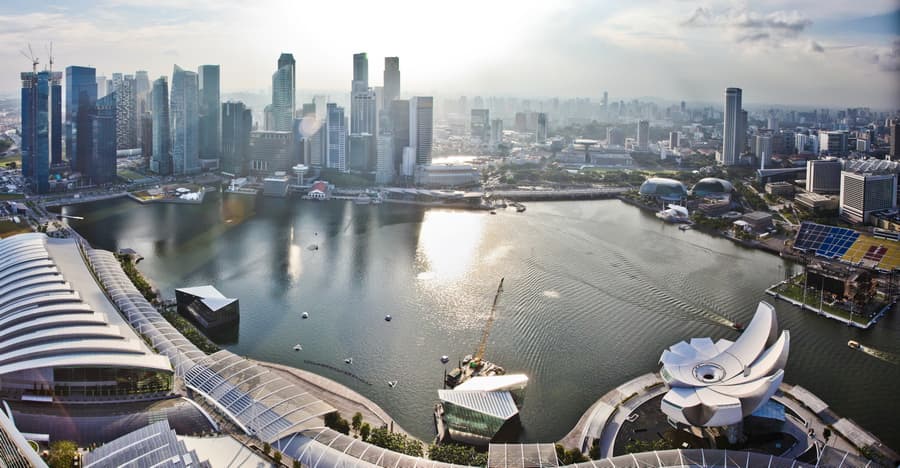
Image: Marina Bay Sands panorama — Vicsandtheworld / CC BY-SA 3.0. See the image credits page.

Singapore – The old site had a soft spot for Swiss–Singapore items. A memorandum of understanding, a visit from a SIX Digital Exchange executive, a photograph of two flags, and the corridor was open for business. The instinct was understandable. Zurich and this city are both wealth centres with serious market infrastructure, complementary clocks, and supervisors who prefer a rulebook to a slogan. The instinct was also inflating. A corridor is a pattern of flights, calls and counterparties. It is not a statute. It does not passport a licence. It does not make a token conservative.
This briefing is a homage to that older piece and a correction of it. It is not a recommendation to list anywhere, to open a family office, or to hold any digital asset. For the city’s own positioning, see Singapore as an Asia digital-asset hub. For the wealth-management half of the same conversation, see family offices and digital assets in Singapore. Adjacent industry colour lives in the industry hub.
What people mean when they say “corridor”
In trade, a corridor is a pair of places that send a lot of the same thing through each other: goods, people, documents, risk. In digital assets the word has been asked to do more work than that. It has been asked to mean that a listing in one city is relevant in the other, that a custody relationship can be “shared”, that a family with a Singapore vehicle and a Swiss bank is in a special legal category.
Strip it back and three ordinary facts remain.
The clocks fit
Zurich’s morning overlaps Singapore’s afternoon. A trading, operations or compliance question can be staffed in one city while the other is still at the desk. That is not romance. It is why commodity and foreign-exchange houses already ran Asia–Europe books through this pair long before anyone tokenised a bond. A Sunday night bitcoin move still belongs to Asia. A Monday morning European fund decision still belongs to Zurich. The corridor, in this thin sense, is a staffing pattern.
The wealth is in both places
Private banks, independent asset managers, and family offices exist in Switzerland and in Singapore for reasons that have nothing to do with a blockchain: political stability, professional services, a habit of cross-border custody. When those organisations look at a digital-asset sleeve, they look for a counterparty they already know how to diligence. Sometimes that counterparty is in the other city. Sometimes it is not. The sleeve does not become a regulated product because the video call has two skylines in the background.
The listing cultures should stay different
Singapore’s listed-securities world already runs through SGX and the Central Depository. Switzerland’s experiments with DLT trading and settlement — SDX and the surrounding federal DLT legislation — sit inside a Swiss perimeter. A tokenised bond that is a Swiss-law instrument on a Swiss venue is not, by that fact, a product a Singapore intermediary may offer to a retail customer in Toa Payoh. A digital payment token on a MAS-licensed platform is not, by that fact, admitted to a Swiss trading facility.
A corridor that forgets those three sentences becomes a brochure.
Complementary time zones are a reason two operations teams can share a shift. They are not a reason two licences can share a customer. The first is logistics. The second is a statute.
SDX, SGX, and the temptation to rhyme
SIX Digital Exchange was built as a regulated DLT venue and central securities depository in Switzerland. SGX is Singapore’s established exchange group, with a depository habit that dematerialised paper a generation ago and a public conversation about tokenised products that comes and goes. The old coverage liked to rhyme the acronyms. Rhyme is not recognition.
What a Swiss DLT listing can mean, at most:
- A Swiss-law product, with Swiss-law custody and Swiss-law insolvency, trading on a Swiss-supervised venue.
- A wholesale or qualified audience defined by Swiss rules, not by the Securities and Futures Act 2001.
- A technology experiment that Singapore market infrastructure may watch, copy in part, or ignore.
What it does not mean:
- That MAS has looked at the product.
- That a Singapore financial adviser may recommend it.
- That a Payment Services Act licence is a distribution channel for it.
- That a family office here has a special right to it.
The reverse is also true. Project Guardian, tokenised fund pilots, and whatever SGX does or does not list are Singapore and, where banks are involved, international-bank conversations. They do not write Swiss law. They do not put a DPT onto SDX. Two serious venues in two serious cities can work on similar problems without sharing a perimeter.
Memoranda of understanding between supervisors are real documents. They are about information and cooperation. They are not product passports. A press release that treats an MoU as a listing is doing the old site’s genre.
Wealth, desks, and the people who actually fly the route
The corridor, when it is not a slide, is people. A Swiss independent manager with Asian principals. A Singapore family office that already banks in Geneva. A custody or prime-brokerage conversation that starts in one city because the credit officer sits there. An audit firm that can sign in both places. A law firm that knows when a token is a DPT here and a different object there.
Those people do not need a metaphor. They need a legal entity, a custody agreement, and a clear statement of which regulator can inspect which book. The 2025 digital token service provider clarification in Singapore made one version of the metaphor more expensive: a Singapore company whose only customers were overseas was told, in substance, to cease. A corridor strategy that was “incorporate in Singapore, serve Swiss and European clients from a letterhead” ran into that sentence. The hub essay is the place for what that means for the city’s brand. The corridor point is narrower. If the Singapore end of the pair cannot see the customers, MAS has said it does not want to license that end.
Switzerland has its own versions of that problem and its own answers. FINMA is not MAS. A FINMA authorisation is not a PSA licence. Treating them as interchangeable is how a landing page gets written and how a complaint later has no address.
What a corridor does not do
It does not create a third jurisdiction called “Swiss–Singapore”. Contracts are still governed by a chosen law. Insolvency still happens in a chosen court. A customer agreement that names a Cayman company, a Swiss bank as sub-custodian and a Singapore marketing affiliate is three facts, not one corridor.
It does not relax Singapore’s retail access rules. A licensed DPT platform here still cannot offer retail leverage, still cannot take a credit card for a token purchase, and still cannot pay people to trade. A Swiss product’s marketing tone does not travel into that app.
It does not make “MAS licensed” or “FINMA supervised” a comment on a token’s value. Both licences are permissions for firms to carry on activities. Neither is an approved-token list.
It does not replace operational due diligence. A family that uses counterparties in both cities still has to ask who holds the keys, who reconciles the book, what happens on a failure, and whether anyone is name-dropping a regulator. That work is the subject of the family-office briefing. The corridor does not do the work for them.
How to read the next joint announcement
The announcements will keep coming. Two flags, a fintech agreement, a “strategic partnership”, a pilot that names both cities. A useful habit, and not an investment process:
- Which legal entities signed, and which activities are they authorised to carry on in each country?
- Is the product a tokenised regulated asset, a digital payment token, or a slide?
- Who is the customer — wholesale banks, family offices, or the public — and in which city does that customer sit?
- If the partnership vanished tomorrow, which supervisor would still be looking at which book?
If the answers are flags and slides, you are reading the old genre. If the answers are entities, activities and books, you are closer to a corridor that exists.
This newsroom will continue to cover Swiss and Singapore market-infrastructure news as industry fact. We will not treat a photograph of two skylines as a legal instrument. Readers who want the Singapore hub argument should stay with Singapore as an Asia digital-asset hub. Readers who want the family-office operational questions should go to family offices and digital assets in Singapore. The rest of the beat is in the industry hub.
Nothing here is an invitation to list, to deal, or to treat either city as a substitute for a customer agreement. A corridor is a route. It is not a recommendation to travel.
Questions readers send the desk
- If a token is listed or discussed in Switzerland, can it be offered to Singapore retail customers?
- Not by that fact. A Swiss venue, including a DLT trading facility, does not confer a Monetary Authority of Singapore permission. Offering a digital payment token or a capital-markets product to people in Singapore still depends on the Singapore statutes and on the local entity’s licence.
- Does a Singapore family office “using the corridor” change the tax or licensing analysis?
- A corridor is a business narrative. It does not move a licence, create a tax residency, or turn an unregulated token into a regulated fund unit. The family’s Singapore analysis and the Swiss analysis have to be done separately, on the actual entities and products.
- Is this a recommendation to use Swiss or Singapore infrastructure?
- No. This article describes how two centres talk about each other. It is not a recommendation to list, to custody, to incorporate, or to hold any token in either place.