Singapore as an Asia digital-asset hub
An honest account of what the city actually is in this industry — a serious payments rail, a strict marketing perimeter, a talent market, and a supervisor that declined to be a flag of convenience — and why “crypto-friendly” is the wrong word.
Editorial Desk · 30 April 2026 · Updated 30 April 2026
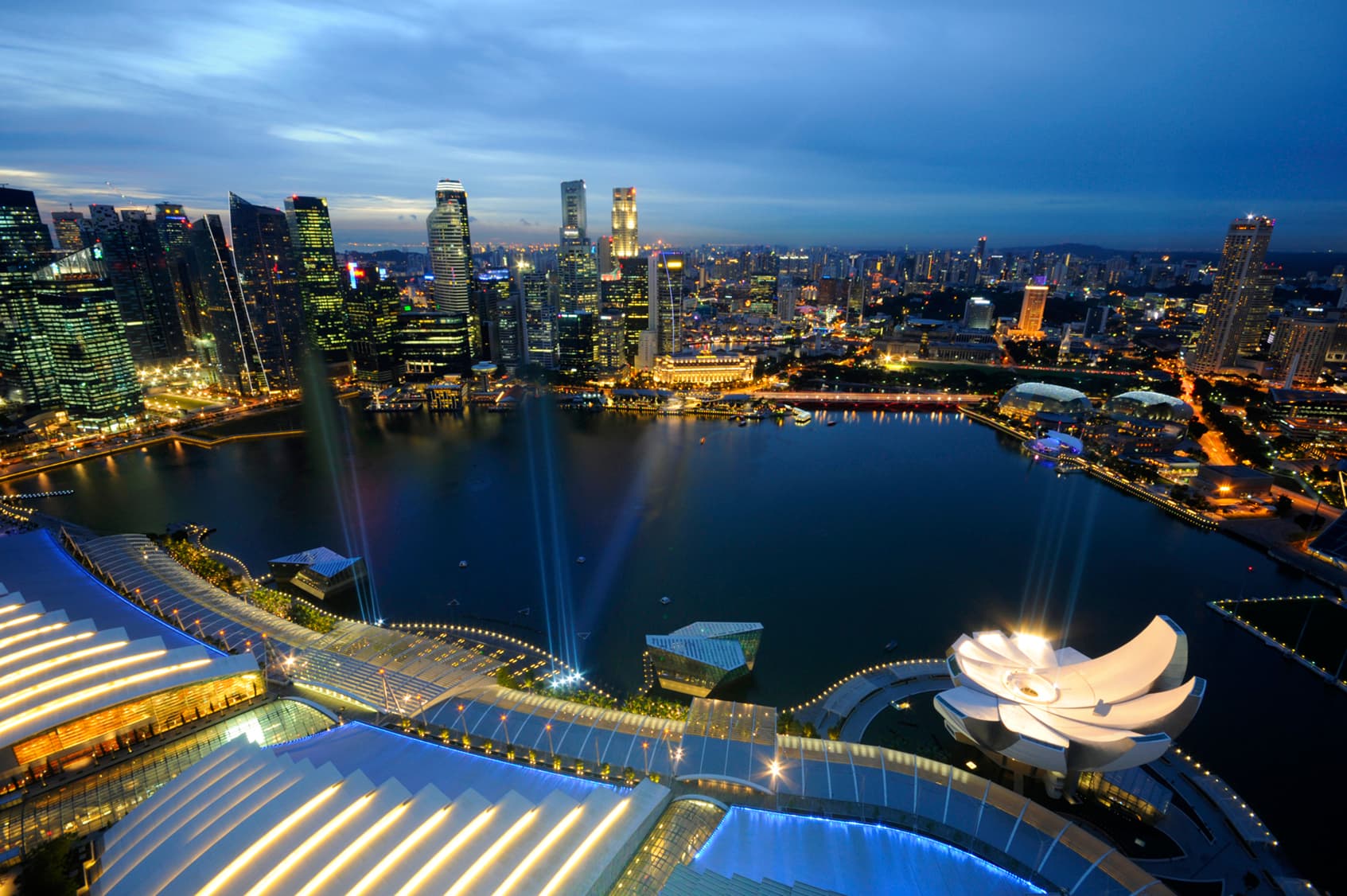
Image: Marina Bay and the Singapore skyline at dusk — William Cho / CC BY-SA 2.0. See the image credits page.

Singapore – The old cryptonews.sg liked a genre that the rest of the region liked too: the Asia-Pacific fintech hotspot list. A skyline photograph, a count of start-ups, a sentence about “smart nation”, and the city was on the podium with Hong Kong, Tokyo and whoever had just announced a sandbox. The instinct was not empty. This is a trade and payments city with a supervisor that publishes in English and a workforce that can staff a compliance meeting at nine and a bank integration at two. The mistake was the adjective. “Friendly” was always the wrong word for what MAS was building.
This is an industry briefing, not a pitch deck and not a recommendation to locate a firm, hire, or hold a token. Digital payment tokens can fall to zero in a well-regulated city. For the 2025 decision that closed the outbound-only letterhead model, see the DTSP regime — what changed in 2025. For the market-infrastructure half of the same story, see tokenisation, SGX and market infrastructure. Colour that does not belong on a licence application lives in the industry hub.
What a hub is, when you remove the brochure
A hub, in the boring sense, is a place where several necessary things are already true: you can move money, you can hire people who know the rulebook, you can talk to banks that will still take your call, and you can name the statute that applies when a product crosses a line. Singapore has those things. It also has a supervisor that treats digital payment tokens as high-risk instruments and says so in public.
That combination is rare and easy to mis-sell. International founders heard “Asia hub” and pictured a light-touch booking centre with good food. What they were offered was a payments licence, a set of consumer-access measures that make a retail app look broken to anyone who has used an offshore clone, and, from 30 June 2025, a general refusal to license a Singapore company whose entire customer book lives abroad.
The honest account is therefore mixed, and the mix is the point.
The payments rail is strong. FAST, PayNow, a real-time gross settlement system, and a banking sector that can do ordinary corporate onboarding when it chooses to, are why a licensed DPT platform here can look like a payments product rather than a casino. Tokens still sit outside that rail. A well-run Singapore-dollar payment does not make a token conservative. It makes the fiat half of a purchase reliable, which is a different sentence.
The marketing perimeter is tight. The 2022 Guidelines on Provision of Digital Payment Token Services to the Public told firms not to portray DPTs as safe or suitable for everyone, and not to push them at the vulnerable. Physical advertising, celebrity endorsement and the festival tone that other cities still tolerate are supposed to look out of place here. A licensed platform’s marketing should look boring. If it looks like a concert, something is off.
The talent is real and expensive. Compliance officers who have filed a suspicious transaction report, engineers who have shipped a custody control, lawyers who can tell a DPT from a capital-markets product — those people exist in this city because the rest of the financial system already hired them. A digital-asset firm that wants a licence is competing for the same payroll as a bank. That is a hub fact. It is also why “we will hire later” is not a licensing plan.
The word “friendly” hides the design. MAS has spent a decade telling audiences that Singapore wants to be a well-regulated digital-asset centre, not a flag of convenience. The consumer-access package, the safeguarding rules, the travel-rule implementation and the DTSP clarification are chapters of the same book. A founder who wanted friendliness wanted a different city.
“Friendly” was always the wrong adjective. A designed environment — a rail, a marketing perimeter, a talent market and a supervisor that will not pretend to see a book it cannot see — is not a welcome mat.
The 2025 sentence that belongs in every hub essay
On 6 June 2025 the Authority said, in public and without much embroidery, that persons who provide digital token services from a place of business in Singapore, or who are formed or incorporated here, need a Financial Services and Markets Act licence even if every customer is overseas — and that MAS will generally not issue that licence, because it cannot supervise a book it cannot see. Firms in that position were told to cease by 30 June 2025.
That is not a subplot. It is the sentence that tells you what kind of hub this is. A hub that cannot see the customers cannot credibly claim to supervise the firm. Other jurisdictions may host outbound businesses under their own theories. What Singapore declined to do was host the unregulated remainder.
Readers who want the statutory detail should stay with the DTSP briefing. The industry residue is simpler. Some firms wound up the Singapore company. Some moved the customer-facing entity abroad and kept, at most, a non-servicing presence. Some discovered that the Singapore company had been the only thing their overseas bankers liked about them. The licensed retail and wholesale book that serves customers in Singapore was not, by that commencement, given a new product menu. Inward business was already illegal without the right Payment Services Act, Securities and Futures Act or Financial Advisers Act permission.
If a landing page still boasts a Singapore office and then onboards you to an unlicensed overseas entity, you are looking at the structure 2025 was designed to end. A hub photograph is not a licence.
Tokenisation and the part of the industry that looks like market plumbing
The other half of the old hotspot list was always “SGX will list a bitcoin product” or “banks will put a bond on a chain”. Some of that work is real. Project Guardian and the public remarks around tokenised funds and deposits are about assets that already have a legal home — fund units, bonds, wholesale deposits — and about whether a ledger can do issuance, settlement and servicing with less reconciliation.
That work lives next to the Central Depository and next to the habits of wholesale settlement. It does not live next to a meme token in a group chat, even when both objects are called tokens. The tokenisation and SGX briefing is the place for the objects. The hub point is only this: a city that already dematerialised listed securities a generation ago is a plausible place to experiment with a new wrapper. A city that mistakes the wrapper for the asset will write the wrong headline.
MAS has been consistent in public: the interesting work is regulated assets and controlled experiments. That is a different legal and operational world from an unregulated token promoted as “Singapore’s next listing”. A hub that hosts both conversations without separating them is doing marketing, not industry analysis.
What the city is not
Not legal tender, not a casino, not a compensation scheme
It is not legal tender territory. Bitcoin remains a digital payment token. Shops may accept it; they are not obliged to. A tax bill is still in Singapore dollars.
It is not a retail casino. Licensed DPT platforms must not offer retail leverage, must not take credit cards for token purchases, and must not pay people to trade. Offshore apps still do. That contrast is how you tell which perimeter you are in. It is not evidence that the Singapore rules are optional.
It is not a compensation scheme. A licence is not the Singapore Deposit Insurance Corporation. Safeguarding rules improve the starting position in an insolvency. They do not print replacement coins.
It is not a place where a speech about innovation substitutes for a directory listing. “Aligned with MAS”, “built for Singapore standards” and “regional headquarters” are phrases that have done too much work on landing pages. The Financial Institutions Directory is the document. A conference badge is not.
How to read the next hotspot list
The lists will come back. They always do. A useful habit, and not a relocation strategy, is to ask what the list is counting.
- Licensed entities that serve customers in Singapore, or letterheads?
- Payments institutions under the PSA, capital-markets firms under the SFA, or marketing offices?
- Tokenised regulated assets, or tickers that borrowed the word token?
- Jobs in compliance, engineering and operations that exist because a notice requires a function — or conference badges?
If the answers are letterheads, tickers and badges, you are reading the old genre. If the answers are licences, rails and functions, you are closer to the city that actually exists.
This desk will keep the industry hub for the constructive version of the story: listings, bank pilots, the long argument about what a corridor is and is not. The DTSP clarification is the other half of the same sentence. Singapore is a digital-asset hub in the sense that it has a rail, a rulebook, a talent market and a supervisor that will not pretend to see a book it cannot see. It is not a hub in the sense that the adjective “friendly” promised. The adjective was always doing someone else’s marketing.
Nothing here is an invitation to incorporate, to apply for a licence, or to deal in any token. A description of a city is not a recommendation to use it.
Questions readers send the desk
- Is Singapore “crypto-friendly”?
- Friendly is the wrong word. The Monetary Authority of Singapore has built a licensing perimeter for digital payment token services, restricted public marketing, imposed retail access rules, and in 2025 told outbound-only token firms it would generally not license them. That is a designed environment, not a welcome mat.
- Did the 2025 DTSP rules mean Singapore is leaving the industry?
- No. They meant Singapore declined to host businesses whose customers it cannot see. Firms that serve customers in Singapore were already inside the Payment Services Act, the Securities and Futures Act or the Financial Advisers Act. The clarification removed a letterhead model, not the licensed book.
- Does a strong payments rail make tokens a good investment?
- No. FAST, PayNow and a well-run banking system make Singapore dollars move. They do not make a digital payment token conservative, honest or suitable for any reader. Infrastructure is not a recommendation.