The DTSP regime — what changed for Singapore crypto firms in 2025
From 30 June 2025, digital token service providers that serve only customers outside Singapore need a Financial Services and Markets Act licence. MAS has said it will generally not issue one, and those firms were told to cease.
Editorial Desk · 8 July 2025 · Updated 15 January 2026
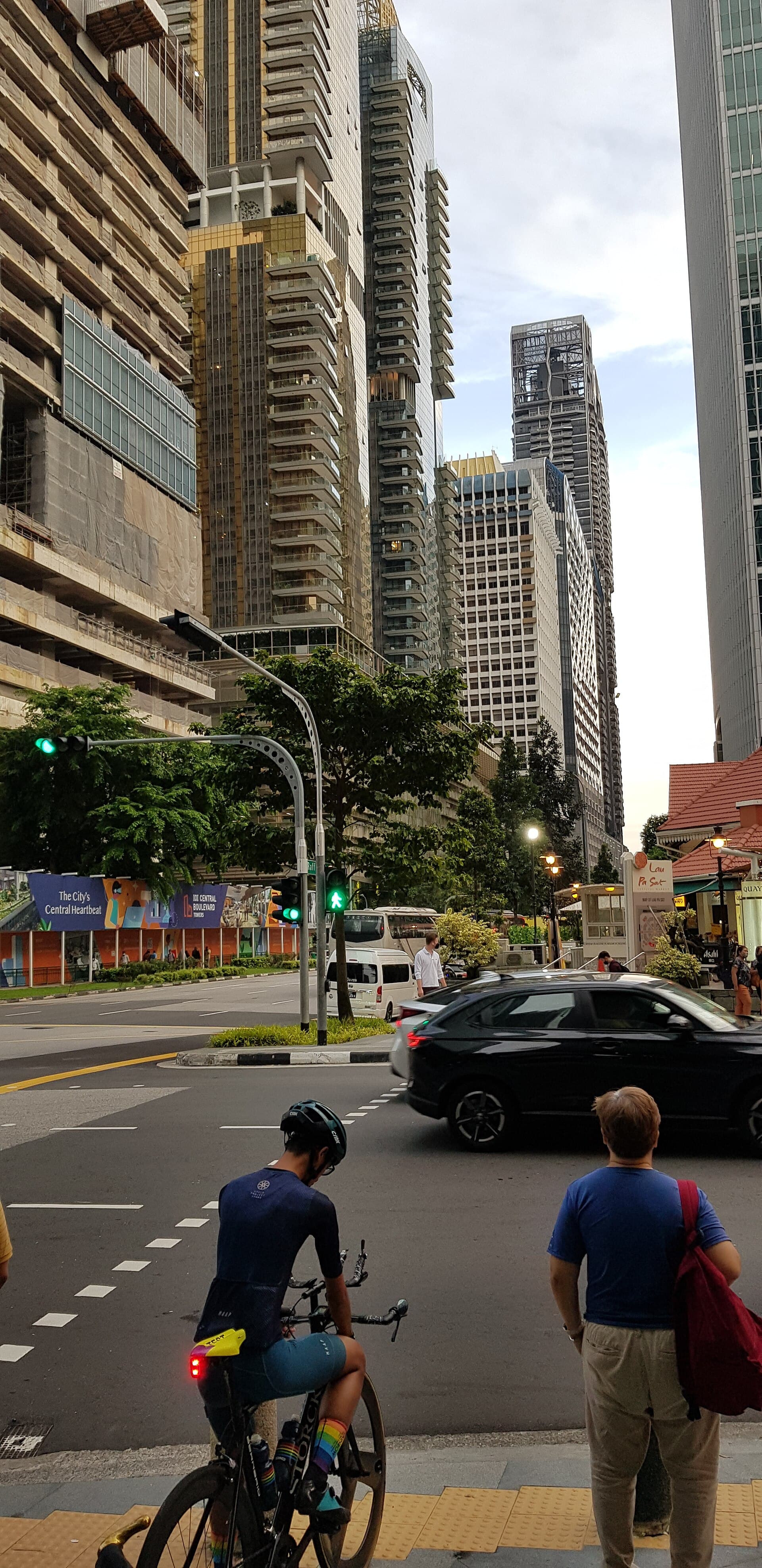
Image: Shenton Way, Singapore — Earthkingfather / CC BY-SA 4.0. See the image credits page.

Singapore – For most of the last decade a particular kind of company liked this city: a Singapore-incorporated vehicle, a shared office on Shenton Way or in the Robinson Road belt, a bank account that looked respectable on a vendor due-diligence form, and a customer book that lived anywhere except Singapore. The tokens were sold to people in other time zones. The local footprint was a registration number and a nominee director. On 6 June 2025 the Monetary Authority of Singapore ended the ambiguity around that model.
The clarification was short and unusually blunt. From 30 June 2025, persons who provide digital token services from a place of business in Singapore, or who are formed or incorporated here, need a licence under the Financial Services and Markets Act 2022 (FSMA) even if every customer is overseas. MAS added that it will generally not issue that licence, because it cannot supervise a business whose customers sit entirely outside its reach. Firms in that position were told to make arrangements to cease.
This article explains what the digital token service provider (DTSP) regime is, what changed in 2025, what did not change for firms that already serve Singapore customers, and why utility and governance-only tokens were carved out. It is not a recommendation to start, move, or use any token business.
The statute that sat in the cupboard
The FSMA is the umbrella financial-services statute Parliament passed in 2022. Among other things it created a licensing regime for digital token service providers. For a few years the regime was easy to ignore if you already lived inside the Payment Services Act, the Securities and Futures Act or the Financial Advisers Act. Those statutes already caught firms that served customers in Singapore. The unfinished question was the outbound business: a Singapore company, or a team operating from Singapore, whose customers were all abroad.
That question had a policy history. MAS has spent a decade telling international audiences that Singapore wants to be a well-regulated digital-asset centre, not a flag of convenience. The industry hub is full of the constructive version of that story — listings, bank pilots, the long argument about Singapore as an Asia digital-asset hub. The DTSP clarification is the other half of the same sentence. A hub that cannot see the customers cannot credibly claim to supervise the firm.
Digital token services, in the FSMA sense, cover the dealing, facilitating of exchange, transfer, custody and related services in digital tokens — a category that includes digital payment tokens and digital tokens that are capital-markets products. The regime was never a third licence for the same retail exchange that already holds a PSA permission. It was the statute for the business that had been standing just outside the other three.
What MAS said on 6 June 2025
The Authority’s public clarification, issued three weeks before commencement, can be paraphrased without embroidery.
From 30 June 2025, a person who carries on a business of providing digital token services from a place of business in Singapore, or who is formed or incorporated in Singapore, needs a DTSP licence even if the customers are all outside Singapore. MAS has assessed that it will generally not be able to supervise such businesses effectively, and will therefore generally not issue a licence to them. Persons in that position should cease the business by 30 June 2025.
Three words in that paraphrase do a lot of work.
Generally leaves a narrow theoretical gap. The default answer is no. Anyone who read “generally not” as “apply anyway and see” was reading against the grain.
Effectively is the supervisory reason. A regulator can inspect a Singapore office. It cannot reconstruct a complaint book, an asset trail and a market-conduct record that exist only in other countries, under other privacy laws, in other courts. A licence MAS cannot supervise is, in its long-held view, a form of accidental endorsement.
Cease is the operative verb. There was no long grandfathering period after 30 June 2025. The 6 June statement was the warning; commencement was the deadline. Firms that needed to close entities or novate contracts had three weeks of official clarity and, if they had been reading the FSMA, rather longer than that in substance.
What did not change
The clarification was equally clear on the complementary point, and this is the point retail readers in Tampines or Tiong Bahru actually need.
Providers that serve customers in Singapore were already required to be licensed under the Payment Services Act 2019, the Securities and Futures Act 2001 or the Financial Advisers Act 2001, depending on the activity. The DTSP regime does not rewrite those licences. It does not add a new product a PSA major payment institution may now offer. It does not relax the risk-awareness, no-credit-card, no-leverage or safeguarding rules described in how MAS regulates digital payment tokens. It does not create a back door for an unlicensed overseas brand to serve Singapore residents through a newly minted FSMA permission.
If you were a customer of a licensed Singapore DPT platform on 29 June 2025, the 30 June commencement did not, by itself, change what that platform was allowed to sell you. If you used an offshore app that had never been licensed here, the DTSP regime also did not license that app. The regime was about Singapore-based businesses looking outward. Inward business was already illegal without the right PSA, SFA or FAA permission. “No change” means no change to the scope of permitted activity for firms already correctly licensed for Singapore customers. It does not mean those firms could add a purely overseas book without thinking about the DTSP perimeter. Group structures still need to be read entity by entity.
Who was actually in scope
The regime is triggered by a combination of activity and location.
Activity. Providing digital token services as a business: dealing, facilitating exchange, transferring, providing custody, and the adjacent services the FSMA and its regulations describe. A one-off private sale is not the target. A business that holds itself out as moving or storing other people’s tokens is.
Location. A place of business in Singapore, or a Singapore formation or incorporation. The test is not “where do the servers sit?” and it is not “where does the founder’s passport come from?” A foreign company that runs the customer book from an office here is in. A Singapore-incorporated company whose staff sit in Lisbon is in. A foreign company with no Singapore place of business and no Singapore incorporation, serving only foreign customers, is a matter for the other country’s regulator.
Customers. For the June 2025 clarification, the politically important customer set was “only outside Singapore”. That is the set MAS said it would generally not license. Mixed books — Singapore plus overseas — are a different corporate and licensing design, and they run through the PSA, SFA or FAA for the Singapore-facing work. They are not a DTSP loophole.
Utility and governance tokens: the carve-out that is narrower than it sounds
MAS said that digital tokens used solely to pay for goods or services provided by the issuer, or that confer governance or voting rights in relation to a network, and that do not have the other characteristics of a digital payment token or a capital-markets product, are not in scope.
Read that sentence slowly. The carve-out is for tokens that are only those things. A “governance token” that is also widely used as a medium of exchange is not saved by the word governance. A “utility token” that raises capital by promising a share of fees is not saved by the word utility. A membership NFT that is actually a unit in a scheme will be analysed as a unit in a scheme.
The carve-out exists because Parliament did not intend to put every restaurant loyalty point and every software-licence key through a financial-services licence. It does not exist to let an offshore exchange relabel its listing as a governance programme. If the token trades on a secondary market as a speculative instrument, the “solely” in the Authority’s formulation has already failed.
Why the industry heard this as a relocation event
By January 2026, when this piece was updated, the residue was visible in filings. Some outbound-only firms wound up their Singapore companies. Some moved the customer-facing entity abroad and kept, at most, a non-servicing presence here. Some discovered that the Singapore company had been the only thing their overseas bankers liked about them.
That is not a morality play. Other jurisdictions may host businesses that serve the world under their own theories. What MAS declined to do was host the unregulated remainder. Firms that wanted a Singapore licence for a Singapore customer book already knew the door: the PSA, the SFA, the FAA, the capital, the consumer-access measures. The door that closed led to a Singapore letterhead and no Singapore supervisor. The honest reading of 2025 is not “Singapore turned against crypto”. It is that Singapore declined to be a booking centre for customers it cannot protect. Whether that makes the city a more or less attractive Asia digital-asset hub is an industry argument. The clarification removed the regulatory puzzle.
What a retail reader should take from a wholesale rule
Most readers of this site will never apply for a DTSP licence. The useful residue is diagnostic.
If a firm advertises a Singapore office but onboards you through a foreign entity, you are looking at the structure the 2025 regime was designed to stop. If it says it “left Singapore because of DTSP” and then solicits Singapore residents, it has not understood the regime. If it says its governance token is unregulated, ask whether the token is solely a voting right, or a voting right plus a trading pair plus a promise of fees.
If you are a customer of a licensed Singapore DPT or capital-markets firm, do not read every 2025 headline as a change to your account. Check the entity on the contract and the MAS directory. The DTSP regime was a decision about the city’s role in other people’s markets. The market in which you are the customer was already spoken for.
This desk will add a correction note if MAS issues a licence against its stated general practice, or if Parliament amends the FSMA perimeter. Until then, the 6 June 2025 clarification is the plain-English version of the law as the Authority intends to administer it. It is not legal advice for a firm deciding whether to wind up, and it is not an invitation to deal.
Questions readers send the desk
- Did the DTSP rules change what licensed Singapore exchanges can offer locals?
- No. Firms that already serve customers in Singapore under the Payment Services Act, the Securities and Futures Act or the Financial Advisers Act were not given a new product menu. The 2025 regime was aimed at using Singapore as a base for unregulated overseas business.
- Why would MAS refuse to license a firm that has no Singapore customers?
- The Authority’s public position is that it cannot effectively supervise a business whose customers, assets and complaint trail sit entirely outside Singapore. A licence it cannot supervise is, in that view, worse than no licence.
- Are utility or governance tokens caught by the DTSP regime?
- Tokens used only to pay for the issuer’s own goods or services, or that only confer governance or voting rights on a network, and that do not otherwise behave as digital payment tokens or capital-markets products, are outside the scope MAS described. The moment the token is used as a medium of exchange or structured as a security, the analysis changes.